Dreamland Decoded
ROLE
Website Developer
DURATION
July - August 2026
PROJECT SCOPE
A seven-week independent research
and design project.
TOOLS
Squarespace, Adobe Illustrator
OVERVIEW
Dreamland Decoded is an educational website about the science of dreaming, built to live in the space between dense academic research papers and astrology-style content about what dreams “mean.” The site was designed to make dream research genuinely accessible to a curious, general audience, bridging a gap I kept running into in my own research on the topic.
As the sole person behind the project, I was responsible for every stage of the process: researching and writing all copy, designing the visual system, building interactive and motion graphics, developing the site in Squarespace, and managing my own production schedule from week one through launch.
OBJECTIVES
The objective was to design and build a website that made dream science approachable without oversimplifying it, every claim backed by a real, cited source, but written in accessible, conversational language. The site needed to guide a general audience through four connected content areas, using short cards, expandable sections, and visuals to encourage exploration rather than passive scrolling, while staying realistic about what one designer could research, write, and build within a seven-week deadline.
DELIVERABLES
The final deliverable was a fully built, live educational website (dreamlanddecoded.org) developed independently on Squarespace over seven weeks, encompassing four core content sections (Why Do We Dream, The Brain, Dreaming Types, and What Does It All Mean) each built from original research and written copy. The project also included custom CSS and code blocks for interactive elements, After Effects motion graphics, and interactive charts, along with a complete citation system featuring inline sourcing and a full bibliography. Supporting the build were seven weekly blog posts documenting the design and research process in real time, as well as a project plan document and Trello board used to manage weekly production milestones from concept through launch.
OUTCOME
The finished site, live at dreamlanddecoded.org, delivers four fully built content sections covering the history and theories of dreaming, the neuroscience of sleep stages and brain waves, dreaming types such as lucid dreaming, sleep paralysis, and nightmares, and dream meaning and recall. The final product is a genuinely educational, cited, and visually cohesive website that also reflects real growth in my own skill set, including new proficiency in Squarespace custom code, After Effects motion graphics, and interactive chart building.
-
DEFINE
Identify what a general audience needs from dream science content that neither academic papers nor astrology sites currently provide.
-
IDEATE
Explore site structure, content hierarchy, and visual direction that balance credibility with accessibility.
-
PROTOTYPE
Sketch wireframes, build the visual system, and construct each page in Squarespace, including custom code and motion graphics.
-
TEST
Run informal user testing, gather outside feedback, and revise navigation, clarity, and citations before launch.
Getting Started & Process Breakdown
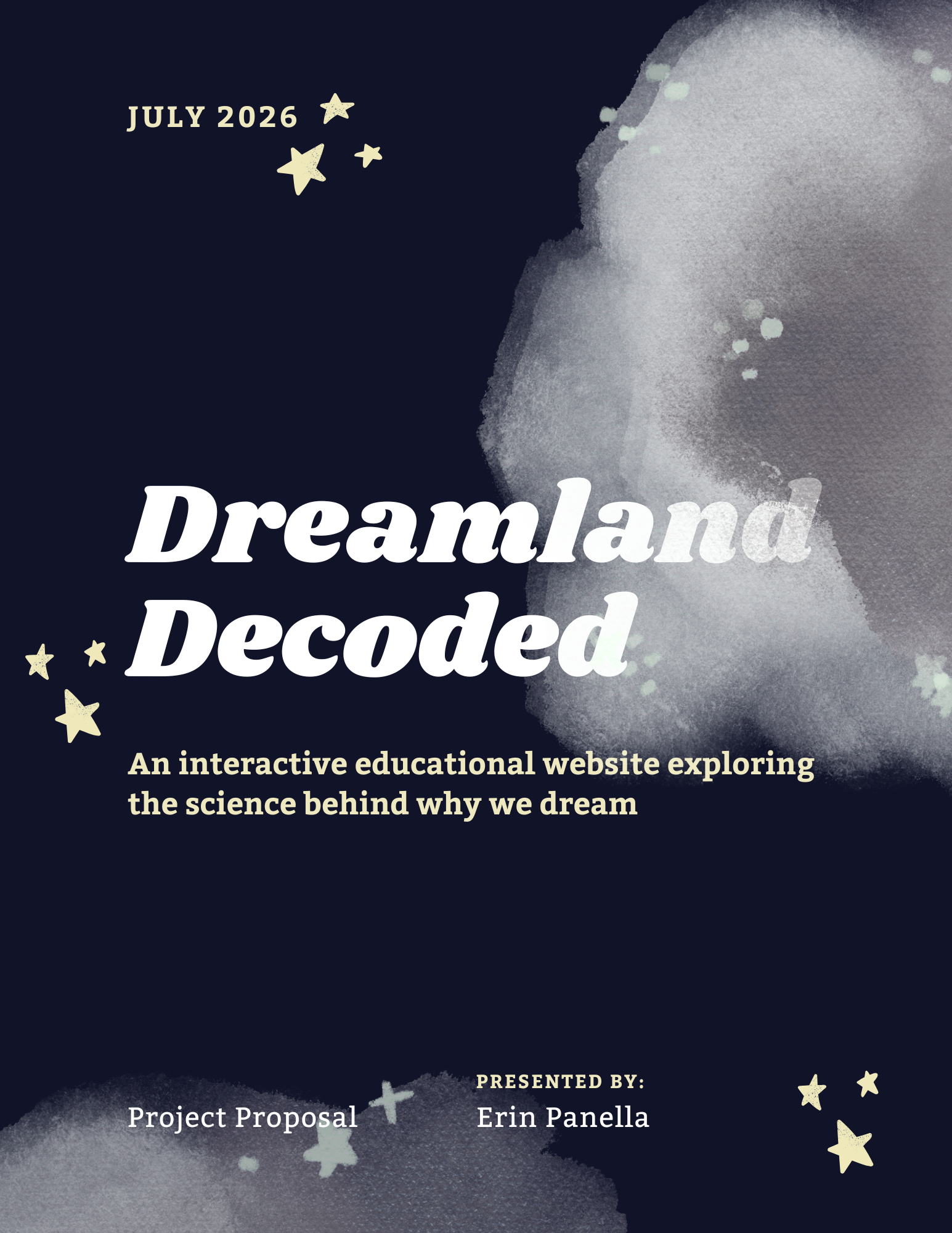
PROJECT PROPOSAL
Click image to view the full document
FINDING MY TOPIC
Dreaming was not the first idea on the list. Early topic options included animal social structures, common superstitions, the psychology of creative blocks, and disappearing languages, all interesting, but none that felt worth a full seven-week deep dive. The topic of dreaming came out of a genuinely ordinary moment: waking up from a vivid dream, describing it to a friend, and realizing that “why do we dream” was a question I had been personally asking for years without ever actually researching. Dreaming had a built-in advantage the other topics didn’t: it was something I was deeply curious about, and something literally everyone experiences, whether they remember it or not.
DECIDING THE MEDIUM
A website was the clear choice over a newsletter or long-form written piece, since the goal was letting people explore at their own pace and follow their own curiosity rather than read straight through a dense article. Early research focused specifically on what makes educational content actually work for a general audience, which reinforced that planning content and structure up front, and building in real points of engagement, measurably affects whether information sticks (Cook & Dupras, 2004). That research shaped the site’s structure from the start: short cards, click-to-expand sections, and visuals throughout rather than long blocks of text.
Read more about my week 1 process and choosing my topic here: Dreaming Up The Idea.
VISUAL DIRECTION
Before opening Squarespace, I sketched rough layouts and mapped out page flow to figure out what each section needed to include. The color and type direction aimed for something dreamy and moody, but with enough contrast to keep the site legible, paired with a type system balancing a scientific tone with a sense of dreaminess between headlines and body copy.

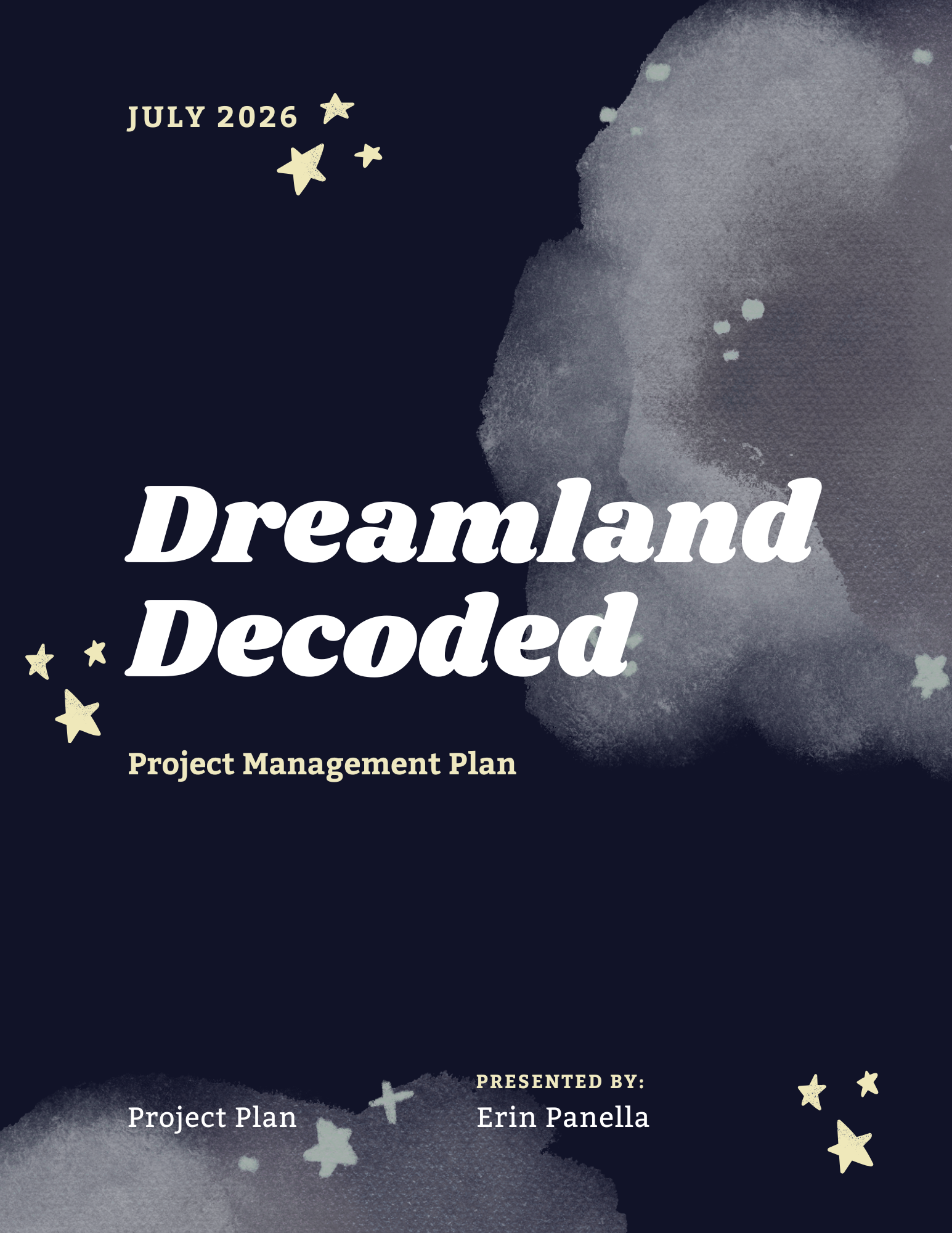
DETAILED PROJECT PLAN
Click image to view the full document
PROJECT MANAGEMENT
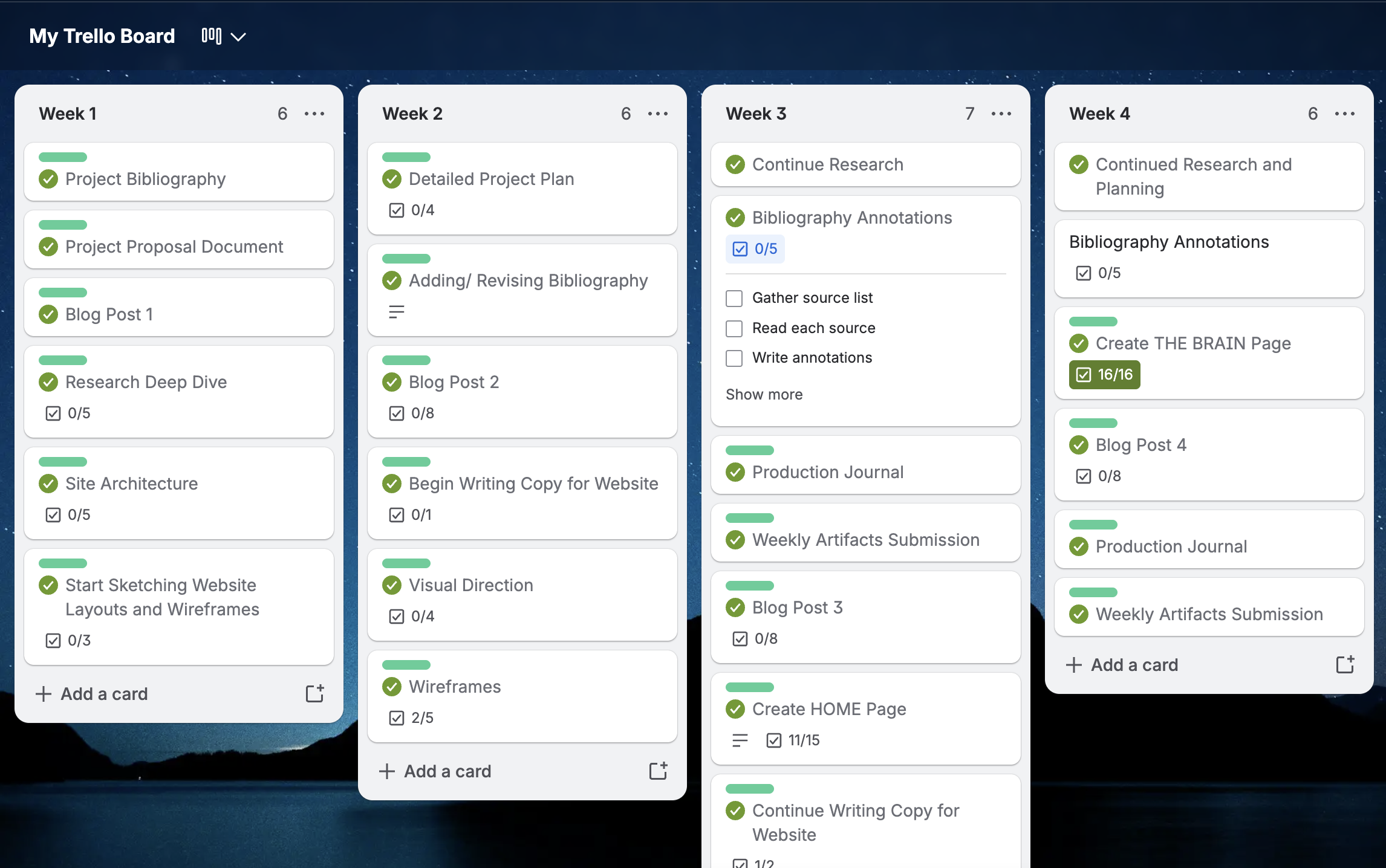
To stay on track across seven weeks, I built a Trello board with one list per week, each broken into task cards with granular checklist items. Breaking work into small, specific action items rather than broad tasks made an enormous difference in actually starting work, a strategy grounded in chunking and microproductivity: breaking a large project into small, well-defined milestones so progress is measurable rather than just feeling generally busy.
Alongside the board, I wrote a full project plan document outlining the seven-week approach, which doubled as a reference point to return to whenever the scope of the project felt hard to hold in my head all at once.
Read more into week 2 in my blog: Reaching For The Moon, One Small Step at a Time.
MY TRELLO BOARD
BUILDING IT OUT
Each of the four sections followed the same process: research and note-taking, drafting website copy, building visual assets, and finally wireframing and building the page in Squarespace.
Why Do We Dream went first, covering the history of dream science from early interpretation through Freud, Jung, and current competing theories, along with a set of cards on the most common reported dreams.
Read about my week 3 process in my blog: Dreaming Up Progress.
The Brain came next and required the most new skill-building, including new Squarespace code techniques, interactive graphs, and After Effects motion graphics built to visualize how brain waves shift across sleep stages.
Read about my week 4 process in my blog: Dream Big, Rebuild Bigger.
Dreaming Types covered lucid dreaming, sleep paralysis, and nightmares, translating specific, technical findings, such as the gamma-wave activity tied to lucid awareness (Voss et al., 2009; Radtke, 2025) and the REM-related mechanics behind sleep paralysis hallucinations (Vijay Bhalerao et al., 2024), into accessible copy without losing accuracy.
Read about my week 5 process in my blog: Awake, Asleep, and Everything In Between.
What Does It All Mean closed out the site, covering dream recall, why dreams often echo real waking experiences (Eichenlaub et al., 2018), and a trainable, five-step checklist for improving recall based on current research (Khedkar, 2025).
Read about my week 6 process in my blog: The Last Page: What Does It All Mean?
TESTING, PROOFING, & FINAL CITATIONS
Once all four sections were built, the project shifted from content creation into refinement. I ran an informal round of user testing with friends outside the design program, having them click through the site cold to surface navigation and clarity issues that were no longer visible to me after weeks of close, repeated review. From there, the site went through a full proofread and a complete citation check, making sure every claim on the site linked back to an accurate, correctly formatted source.
Reflection
This project pushed me to work as a planner, researcher, copywriter, graphic designer, motion designer, and developer all at once, and to make real decisions about what a project actually needs versus what I originally imagined it would look like. Along the way I picked up new technical skills I didn’t have going in, including custom CSS and code blocks in Squarespace, After Effects animation, and building interactive charts, simply because the project required it.
There were real setbacks, including losing the entire first build of the site to a Squarespace data loss partway through. What came out the other side is a site that is genuinely educational, a little bit fun, and something I’d actually want to click through myself, which was the whole goal from the start. Seven weeks of research never handed me one clean, tidy answer to why we dream, and neither does the current science. But it did leave me with a finished website I’m proud of, a real stack of new skills, and a much clearer sense of the gap between what I want to build and what I can realistically finish in seven weeks.